a) The intensity of the thrust exerted by the liquid on the body corresponds to 1/3 of the weight of the body.
b) The density of the solid body is 1.6 g / cm³.
c) The density of the solid body is 1.2 g / cm³.
d) The intensity of the thrust exerted by the liquid on the body corresponds to 2/3 of the body weight.
e) The density of the solid body is 3.2 g / cm³
2. Two blocks A and B of the same size and different materials are hung on the ceiling by wires of the same length and immersed in a tub filled with water, as shown below. Cutting the wires, it is observed that A remains in the same position within the water, while B goes to the bottom.
With respect to this fact, it can be stated that the density of the block

a) A is less than B.
b) A is smaller than that of water.
c) B is smaller than that of water.
d) B is less than A.
3.From the top of a bridge, a boy drops a massive, impermeable brick into the still waters of a lake. When it collides with the surface of the water, the brick does not part and sink vertically until it stops at the bottom of the lake.
As it sinks, the density of the brick and the buoyancy module
E → exerted by the water on it are, respectively,

a) increasing and constant.
b) decreasing and constant.
c) constant and decreasing.
d) constant and increasing.
e) constant and constant.
4.The same body is immersed in three different liquids, A, B and C. As the figure shows, in liquid A the body is able to remain at rest, floating on the surface. In liquid B, the body can only rest on the bottom of the vessel; and within the liquid C the body is able to remain at rest without touching either the bottom of the container or the surface of the liquid.

With respect to densities: ρA, ρB, ρC and of the liquids A, B and C respectively, it is correct to state that
a) ρB> ρC> ρA
b) ρA> ρC> ρB
c) pA> ρB> ρC
d) ρB> ρA> ρC
e) pC> pA> pB
5. The figure represents a solid, homogeneous sphere of wood that floats in equilibrium with half the volume submerged in a fluid of density equal to 2.0g / cm³.
Under these conditions, it is correct to state that the density of the wood is equal, in g / cm³,

a) 1
b) 4
c) 2
d) 3
6. In a sporting competition, a weightlifter of 80 kg, lifting a 120 kg metal bar, rests on his feet, whose contact area with the floor is 25 cm2. Considering g = 10m / s² and remembering that pressure is the effect produced by a force on an area, and considering that this force acts uniformly over the entire extent of the contact area, the pressure exerted by the weightlifter on the floor in pascal is:
a) 2 .10*5
b) 8. 10*5
c) 12.10*5
d) 25 .10*5
e) 2 .10*5
*raised to
7. A hollow aluminum cube has 100g mass and volume of 50cm³. The volume of the empty part is 10 cm³. The density of the cube and the specific mass of aluminum are, respectively:
a) 0.5 g / cm 3 and 0.4 g / cm 3
b) 2.5 g / cm³ and 2.0 g / cm³
c) 0.4 g / cm³ and 0.5 g / cm³
d) 2.0 g / cm³ and 2.5 g / cm³
e) 2.0 g / cm³ and 10.0 g / cm³


e) 200 N
12. During a lesson on fluids, the teacher illustrates an important physical principle through an experiment, as shown in the following figure. A block of 150 g is supported on the larger syringe plunger.
 When depressed, the plunger of syringe A travels very slowly 3 cm, and the plunger of syringe B moves 2 cm, raising the block. In relation to this situation, the following statements are made:
Given: acceleration of gravity = 10 m / s2.
I. The force exerted by the teacher on the plunger of syringe A is equal to 2/3 of the weight of the block.
II. The work done by the teacher, when pushing the plunger, is equal to 0.03 J.
III. The pressure exerted by the block on the plunger of the syringe B is greater than the pressure exerted by the teacher on the plunger of the syringe A.
IV. The work done by the teacher on the plunger of syringe A is equal to 2/3 of the work done by the weight force on the block.
The alternative that contains all the correct statements is:
a) I and II
b) I and III
c) II and III
d) II and IV
e) III and IV
13. Mark the correct alternative about Pascal's Principle.
a) The pressure applied on any point of a fluid is not transmitted integrally through all points of that fluid but suffers losses along the path because of the frictional forces between the molecules of the fluid and the walls of the vessel.
b) The pressure applied on a fluid is transmitted integrally to all points of the liquid.
c) The pressure applied on a fluid is transmitted integrally to all points of a fluid since the container is made of smooth material.
d) The pressure applied on a fluid is transmitted integrally to all points of a fluid since the container is made of material with negligible coefficient of friction.
e) All statements are incorrect.
14. A hydraulic press has pistons of areas A and 2A. If an object of 1000 N is placed on the larger piston, what force should be applied on the smaller piston to raise the object?
a) 500 N
b) 450 N
c) 300 N
d) 250 N
e) 950 N
15. Note, in the following figure, the representation of a hydraulic press, in which the forces F1 and F2 respectively act on the pistons of the cylinders I and II.
 Admit that the cylinders are completely filled with liquid. The volume of cylinder II is equal to four times the volume of cylinder I, whose height is three times the height of cylinder II. The ratio between the intensities of the forces F2 and F1, when the system is in equilibrium, corresponds to:
a) 12
b) 6
c) 3
d) 2
ANSWERS
6. In a sporting competition, a weightlifter of 80 kg, lifting a 120 kg metal bar, rests on his feet, whose contact area with the floor is 25 cm2. Considering g = 10m / s² and remembering that pressure is the effect produced by a force on an area, and considering that this force acts uniformly over the entire extent of the contact area, the pressure exerted by the weightlifter on the floor in pascal is:
a) 2 .10*5
b) 8. 10*5
c) 12.10*5
d) 25 .10*5
e) 2 .10*5
*raised to
7. A hollow aluminum cube has 100g mass and volume of 50cm³. The volume of the empty part is 10 cm³. The density of the cube and the specific mass of aluminum are, respectively:
a) 0.5 g / cm 3 and 0.4 g / cm 3
b) 2.5 g / cm³ and 2.0 g / cm³
c) 0.4 g / cm³ and 0.5 g / cm³
d) 2.0 g / cm³ and 2.5 g / cm³
e) 2.0 g / cm³ and 10.0 g / cm³
8.The figure below shows, in a simplified way, the disc brake system of a car. When the brake pedal is depressed, it pushes the piston of a first piston which, in turn, through the hydraulic circuit oil, pushes a second piston. The second piston presses a brake pad against a metal disc attached to the wheel, causing it to decrease its angular velocity.

Considering the diameter d2 of the second piston twice as large as the diameter d1 of the first, what is the ratio between the force applied to the brake pedal by the driver's foot and the force applied to the brake pad?
a) 1/4.
b) 1/2.
c) 2.
d) 4.
9. The figure below shows the operating principle of a hydraulic lift, formed by a system of communicating vessels containing an incompressible fluid inside. Consider that the acceleration of gravity is 10 m / s2. Since the cross-sectional areas of pistons 1 and 2 are respectively A1 = 0.2 m2 and A2 = 1 m2, the force F1 module required to lift the equivalent weight of a load with a mass equal to 100 kg will be:

a) 10 N
b) 50 N
c) 100 N
d) 150 N
e) 200 N
10. A 2000 N weight object is placed over the larger area of a hydraulic lift which has a value of 0.4 m2. Determine the minimum force required to be applied over the smaller area, of value 4 x 10 - 4 m2, so that the object can be raised.
a) 10 N
b) 5 N
c) 1 N
d) 1.5 N
e) 2 N
11. A force F1 is applied over the smaller area of a hydraulic lift. Knowing that the largest area (A2) is the quintuple of the smaller area (A1) and that the force F2 exerted on the larger area is 2000 N, determine F1.
a) 1000 N
b) 500 N
c) 150 N
d) 400 N
12. During a lesson on fluids, the teacher illustrates an important physical principle through an experiment, as shown in the following figure. A block of 150 g is supported on the larger syringe plunger.

Given: acceleration of gravity = 10 m / s2.
I. The force exerted by the teacher on the plunger of syringe A is equal to 2/3 of the weight of the block.
II. The work done by the teacher, when pushing the plunger, is equal to 0.03 J.
III. The pressure exerted by the block on the plunger of the syringe B is greater than the pressure exerted by the teacher on the plunger of the syringe A.
IV. The work done by the teacher on the plunger of syringe A is equal to 2/3 of the work done by the weight force on the block.
The alternative that contains all the correct statements is:
a) I and II
b) I and III
c) II and III
d) II and IV
e) III and IV
13. Mark the correct alternative about Pascal's Principle.
a) The pressure applied on any point of a fluid is not transmitted integrally through all points of that fluid but suffers losses along the path because of the frictional forces between the molecules of the fluid and the walls of the vessel.
b) The pressure applied on a fluid is transmitted integrally to all points of the liquid.
c) The pressure applied on a fluid is transmitted integrally to all points of a fluid since the container is made of smooth material.
d) The pressure applied on a fluid is transmitted integrally to all points of a fluid since the container is made of material with negligible coefficient of friction.
e) All statements are incorrect.
14. A hydraulic press has pistons of areas A and 2A. If an object of 1000 N is placed on the larger piston, what force should be applied on the smaller piston to raise the object?
a) 500 N
b) 450 N
c) 300 N
d) 250 N
e) 950 N
15. Note, in the following figure, the representation of a hydraulic press, in which the forces F1 and F2 respectively act on the pistons of the cylinders I and II.
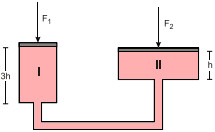
a) 12
b) 6
c) 3
d) 2
ANSWERS
Comments
Post a Comment