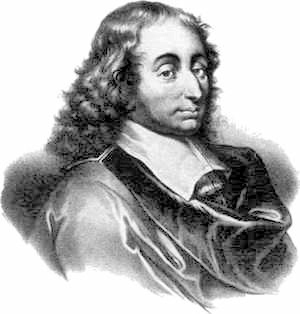
Blaise Pascal (Clermont-Ferrand June 19, 1623 - Paris, August 19, 1662), son of Étienne Pascal, professor of mathematics, and Antoinette Begon. He lost his mother at the age of three. His father dealt with his upbringing because he was the only male son, guiding him to the correct development of his reason and his judgment. Due to his talent for science, the family went to Paris, where Pascal was consecrated by the study of mathematics. He studied a lot of physics, mathematics and developed severe religious theories, including adhering to a new doctrine considered heretical by the Catholic church in the year 1646, called Jansenism*, and influencing the creators of the Methodist church Charles and John Wesley. He lost his father in 1651, and in 1654 gave up the sciences to devote himself to theology and philosophy, and gathering in the center of Jansenism until 1658, when he returned to mathematics. After all this contribution, he became seriously ill in 1659 and died three years later in Paris.
*Jansenism was a Catholic theological movement, primarily in France, that emphasized original sin, human depravity, the necessity of divine grace, and predestination. The movement originated from the posthumously published work of the Dutch theologian Cornelius Jansen, who died in 1638. It was first popularized by Jansen's friend AbbotJean du Vergier de Hauranne, of Saint-Cyran-en-Brenne Abbey, and after du Vergier's death in 1643, was led by Antoine Arnauld. Through the 17th and into the 18th centuries, Jansenism was a distinct movement within the Catholic Church. The theological centre of the movement was the convent of Port-Royal-des-Champs Abbey, which was a haven for writers including du Vergier, Arnauld, Pierre Nicole, Blaise Pascal, and Jean Racine. (Wikipedia)
*Jansenism was a Catholic theological movement, primarily in France, that emphasized original sin, human depravity, the necessity of divine grace, and predestination. The movement originated from the posthumously published work of the Dutch theologian Cornelius Jansen, who died in 1638. It was first popularized by Jansen's friend AbbotJean du Vergier de Hauranne, of Saint-Cyran-en-Brenne Abbey, and after du Vergier's death in 1643, was led by Antoine Arnauld. Through the 17th and into the 18th centuries, Jansenism was a distinct movement within the Catholic Church. The theological centre of the movement was the convent of Port-Royal-des-Champs Abbey, which was a haven for writers including du Vergier, Arnauld, Pierre Nicole, Blaise Pascal, and Jean Racine. (Wikipedia)
Comments
Post a Comment